
Agentic RAG: How to Automate Complex Workflows

From answering questions to solving tasks: agents that plan, verify their own sources and act on your systems under control
Quick Answer
Classic RAG retrieves information once and answers with it: it works well for direct questions about documents. Agentic RAG turns the model into an agent that plans the task in steps, decides at each step which source to consult, whether documents, databases or APIs, verifies whether the information obtained is sufficient and reliable before continuing, and takes actions on other systems through tools.
This makes it possible to automate complete workflows, such as processing a claim or preparing a proposal, that used to require a person to consult several systems and make intermediate decisions.
Autonomy has to come with control: limits on the number of steps, per-tool permissions, human approval for sensitive actions and a record of every decision.
Classic RAG answers with the first thing it finds. An agent checks whether what it has found is enough before answering or acting.
Consider a common question at an insurer or a manufacturer: "can we accept this warranty claim?". Answering it requires consulting the contract terms, which are in documents; the purchase date and model, which are in the ERP; the customer's incident history, which is in the CRM; and, where appropriate, opening a case in the management system. Classic RAG can summarise the warranty terms, but it cannot cross-check them against the customer's data or act on the result.
Today, that work is done by a person jumping between five screens. It is exactly the kind of workflow agentic RAG can automate.
The leap is not that the model knows more. It is that it can decide what it is missing and how to get it.
From Passive RAG to Agentic RAG
A classic RAG system always follows the same path: it turns the question into a search, retrieves the most similar passages and generates an answer from them. We explained its architecture when discussing chatbots with enterprise data. That fixed path has four limits:
- A single retrieval: if the first search does not bring back what is needed, the answer is built anyway from whatever there is.
- A single source: it cannot combine a document with a query to a database or an API.
- No verification: it does not check whether the retrieved information actually answers the question or whether it is contradictory.
- No action: it can explain what should be done, but not do it.
Agentic RAG breaks those limits by replacing the fixed path with a decision loop.
How an Agentic RAG System Works
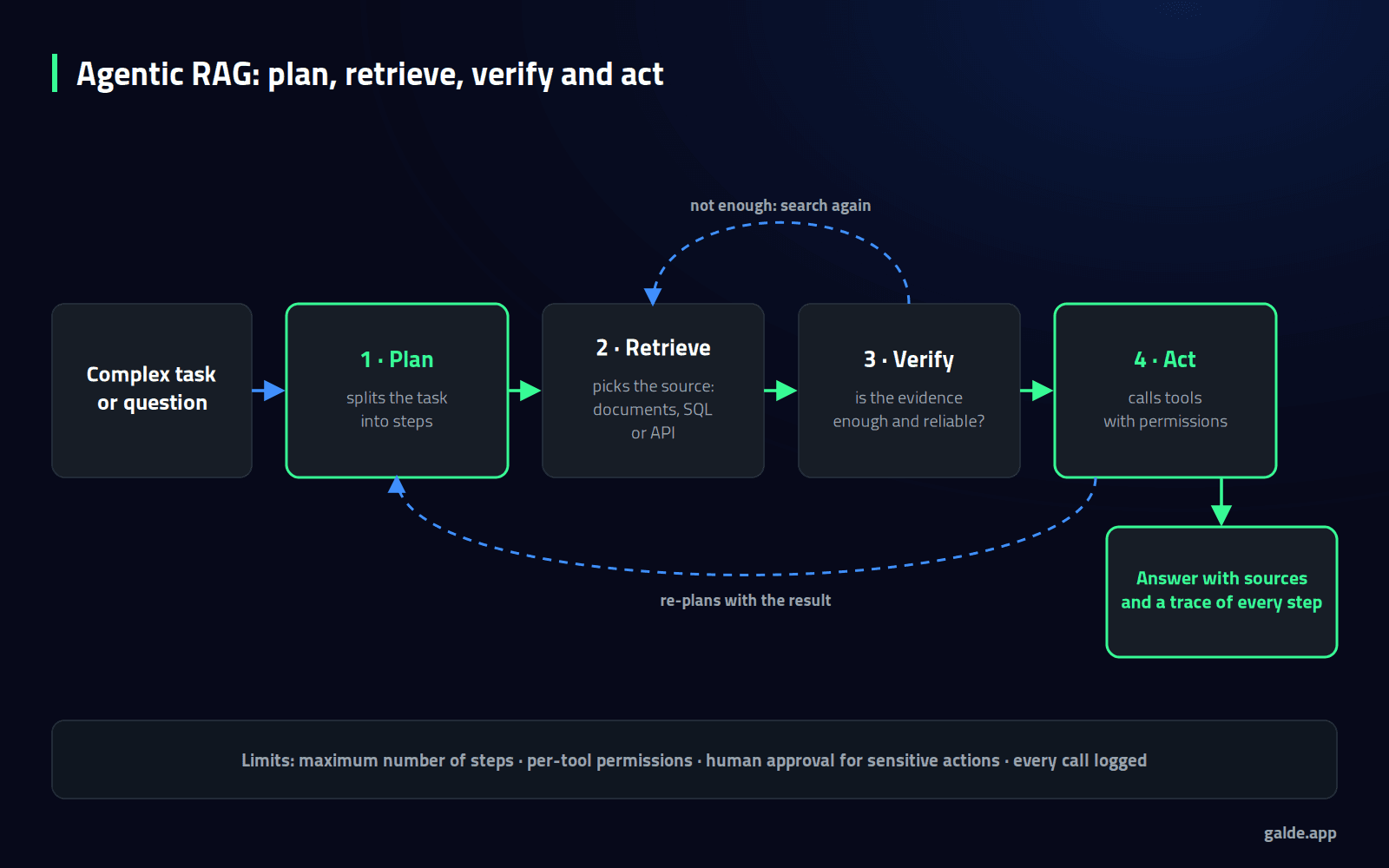
Planning: Splitting the Task into Steps
Faced with a complex task, the agent first breaks it down: what it needs to know, in what order and what it must do with it. In the warranty example, the plan would be to obtain the contract terms, confirm the purchase date, review the history and decide.
Retrieval: Choosing the Right Source at Each Step
For each step, the agent decides where to look: the document index for the terms, a SQL query to the ERP for the purchase date, a call to the CRM API for the history. That ability to route between sources is what lets it combine information that no single index contains.
Verification: Checking Whether the Evidence Is Enough
Before moving on, the agent assesses what it has obtained: whether it answers what it needed, whether it is consistent with what came before and whether it comes from a reliable source. If it is not enough, it reformulates the search or tries another source. Published approaches such as Self-RAG and Corrective RAG formalise this self-critique, and it is the practical difference between a system that improvises and one that corrects itself.
Action: Calling Tools and APIs
Once it has what it needs, the agent acts through tools: functions with a defined description and parameters that let it, for example, open a case, record a decision or send a notification. Open standards such as the Model Context Protocol (MCP) make it simpler to connect those tools in a consistent way.
The loop ends with an answer that includes its sources and a trace of every step, so that anyone can review how it was reached.
Use Cases Where Agentic RAG Adds Value
- Claims processing: cross-checking contract terms, customer data and history to propose a resolution.
- Second-line technical support: diagnosing an incident by consulting documentation, logs and system status, and opening or updating the ticket.
- Proposals and tenders: gathering requirements, past cases, pricing and availability to draft a first version.
- Regulatory and compliance reports: collecting data from several sources, checking its consistency and flagging what is missing.
- Supplier analysis: combining contract documentation, purchasing data and external sources to assess a risk.
The common pattern is a process that today requires consulting several systems, applying known criteria and making intermediate decisions.
Risks and Controls: How to Keep an Agent Under Control
An agent that can act on real systems needs controls designed in from the start:
- Bounded loops: a maximum number of steps, time and cost per task, to avoid loops that consume resources without making progress.
- Least-privilege tools: separating read tools from write tools, and giving each agent only the ones its task needs, with the permissions of the user it serves.
- Human approval for sensitive actions: irreversible actions, or those with financial impact, are proposed but confirmed by a person.
- Retrieved content as data, never as instructions: a document or a web page may contain text that tries to give the agent orders; the system must treat what it retrieves as information, without letting it extend its permissions or change its task.
- Full traceability: logging every step, every query and every call, to audit decisions and debug errors.
- Evaluating the whole task: measuring whether the agent resolves the workflow correctly, not just whether each answer sounds right.
Many of these controls extend what any RAG deployment already requires, as we saw when covering security and sovereignty in RAG architectures.
How to Start: From a Bounded Workflow to Full Automation
- Choose a process with a clear success criterion, frequent and costly, in which a person currently consults several systems.
- Start in proposal mode: the agent investigates and recommends, and a person executes. That way its quality is measured without risk.
- Add actions one at a time, starting with reversible ones, with human approval for the rest.
- Secure the sources before the agent: an agent that decides on out-of-date data is wrong with more confidence. Its sources should be managed as a Data Product.
- Measure and expand: rate of tasks resolved, time saved, human interventions needed and errors caught.
Do you have workflows that today require checking five systems and deciding by hand?
At Galde, we design agentic RAG systems to automate complex workflows end to end, with the architecture, permissions and traceability needed to take them into production in demanding enterprise environments.

How Galde Can Help Automate Complex Workflows with Agents
Through generative AI, we design the agent's loop, the tools and their permissions, source verification and end-to-end task evaluation, from a first workflow in proposal mode to controlled automation.
Through data governance, we define what each agent can consult and do, how its decisions are recorded and how it fits into your organisation's generative AI governance.
And through data platforms, we expose the sources and systems the agent needs through stable, secure and monitored interfaces.
Conclusion
Agentic RAG changes the question from what AI knows to what it can solve. Planning, choosing the right source, verifying the evidence and acting on systems make it possible to automate workflows that used to depend on a person jumping between screens. The value lies in that autonomy, and its viability in the controls that come with it: least privilege, human approval where it matters, full traceability and reliable data sources.
Frequently Asked Questions
What is agentic RAG?
It is an evolution of RAG in which the model acts as an agent: it plans the task in steps, decides which source to consult at each one, verifies whether the information is enough and takes actions on other systems through tools.
How does it differ from classic RAG?
Classic RAG retrieves information once, from a single source, and answers. Agentic RAG retrieves iteratively, combines several sources, checks what it obtains and can act, not just answer.
What are the risks of giving an agent autonomy?
Loops that consume resources, unwanted actions and manipulation through the content it retrieves. They are controlled with step and cost limits, least-privilege tools, human approval for sensitive actions and a log of every step.
What is the Model Context Protocol?
It is an open standard for connecting AI models to tools and data sources in a consistent way. It makes it easier for an agent to use different systems without custom-built integrations for each one.
Where should a company start with agentic RAG?
With a frequent, costly process that has a clear success criterion, in proposal mode: the agent investigates and recommends, and a person decides. Once quality is measured, actions are added gradually.