
Forward Deployed Engineering: The Model OpenAI and Anthropic Are Buying

Why the question of who deploys AI now matters as much as which model you use
Quick Answer
Forward deployed engineering is the model Palantir popularised: instead of handing over software and documentation, the vendor puts its engineers inside the customer's operation, building on real data from the first week and shipping something that works every few days.
In 2026 that model has become the most contested asset in the sector. OpenAI's deployment arm, launched in May with $4 billion, bought Northslope in July — Palantir's first and only Vanguard Elite partner — after earlier acquiring the consultancy Tomoro. Anthropic is also building its own services business.
For anyone hiring, the reading is direct: when models increasingly resemble each other, the difference lies in who takes them into production inside your processes.
A model in a demo and a model inside your ERP are two different things.
For years, Palantir's model prompted an uncomfortable discussion among investors: if you need to deploy engineers inside the customer, is this a software company or a consultancy in disguise? The discussion has been settled in the least expected way — by buying the model.
What matters is not the transaction itself but what it reveals. Value has shifted from the model to the work of embedding it in real processes, with their permissions, their exceptions and their people.
Most companies that get no return from AI do not have a model problem. They have an integration problem.
What Makes a Deployed Engineer Different
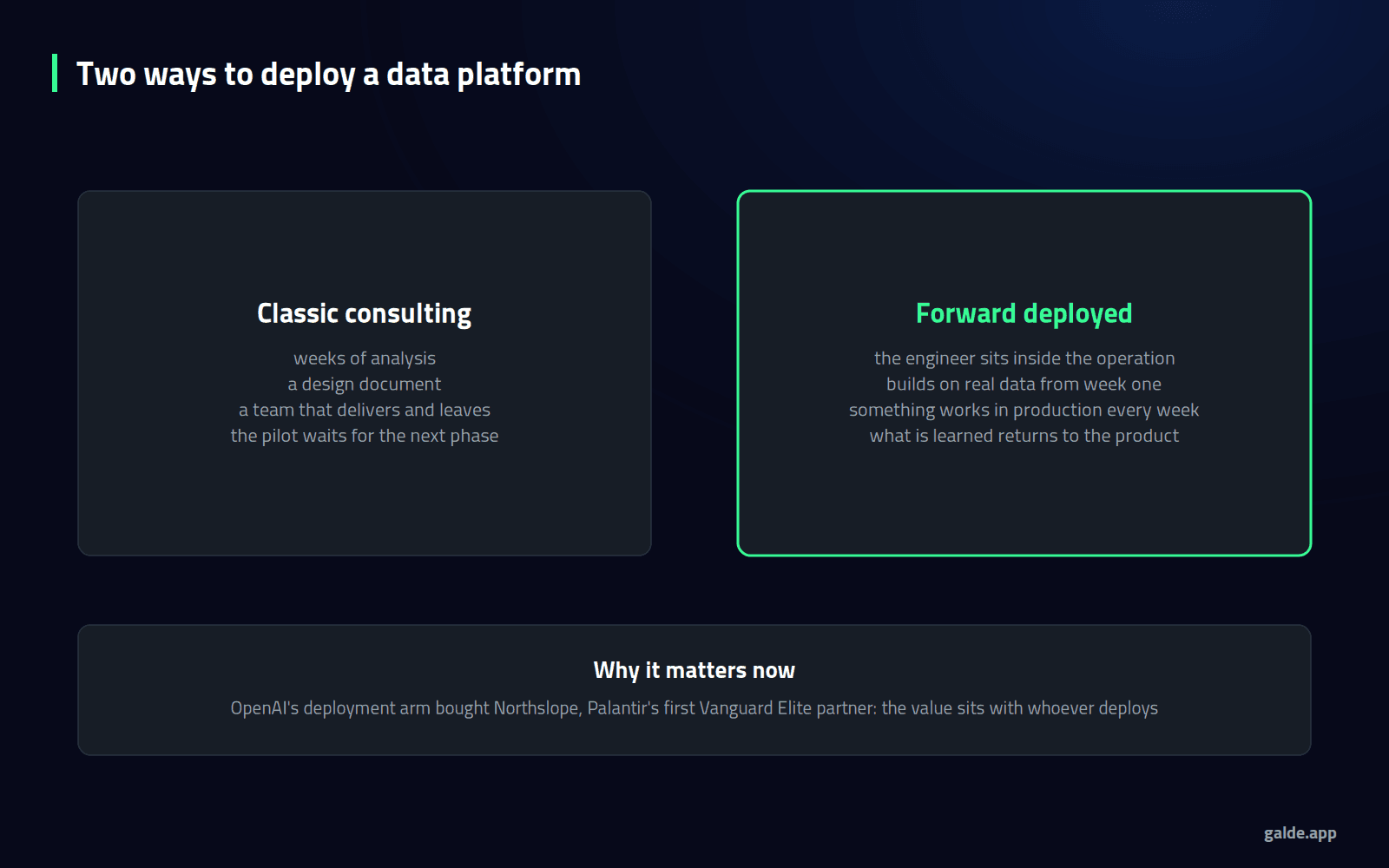
This is not a consultant with a new name. The difference lies in four concrete habits:
- They work where the problem happens, sitting with whoever plans, maintains or processes, not in a project room.
- They build on real data from week one, with its gaps and inconsistencies, rather than on a clean extract.
- They ship something that works every week, however small, instead of a design document validated three months later.
- They feed what they learn back into the product: what repeats across customers stops being bespoke code and becomes functionality.
Why It Suddenly Matters So Much
Three reasons we see in our clients' buying decisions:
- Models have converged. When several providers handle the same task well, competitive advantage moves to deployment.
- Enterprise data is awkward. Real processes are full of exceptions that appear in no manual and are only discovered by working inside them.
- The last mile is where pilots die. We covered this when discussing moving from an AI MVP to a data product: what fails is rarely the model.
The Same Model, Now Automated Too
A parallel move inside the platform itself is worth noting. Palantir documents AI FDE, an agent that works on the customer's environment — editing the Ontology, writing functions or auditing permissions — and that proposes changes in a branch proposal or a pull request for review, rather than applying them on its own.
It is the same idea moved into the product: bring the ability to build closer to where the problem is, while keeping human review.
What to Ask Whoever Offers It
The term has become fashionable and is now used for any consulting team. Four questions separate the real thing from the label:
- In which week will we see something working on our data, not a mock-up?
- Who is the specific engineer who will be inside, and at what dedication?
- How is knowledge transferred to our team so we do not depend on one person?
- What happens to governance and permissions while things are built fast?
The fourth is the one most often forgotten, and the most expensive in a regulated sector.
The Risk of the Model
Working inside the operation accelerates delivery but concentrates knowledge in few people. Without a deliberate practice of documentation and handover, dependency simply moves: from the product to the vendor. In our deployments we counter that with two unglamorous things: the model and the logic kept in the customer's repositories, and a customer engineer paired with ours from day one.
Did your last data project end in a design document rather than in production?
At Galde we work this way on Palantir Foundry deployments for multinational corporations and public administrations: engineers inside the operation, real data from the start, and deliveries that get used.

How Galde Can Help
Through our Palantir consulting and implementation, we deploy teams that build inside your operation, with the governance discipline a regulated sector demands.
Through data platforms, we apply the same approach outside Palantir, as described in data consulting and the modern data stack.
And our methodology sets the commitment: a data product in production in 60 days, with a technical sponsor dedicating two hours a week.
Conclusion
That AI labs are buying firms of Palantir-trained engineers says more about the market than any model comparison: the scarce capability is no longer training but deploying inside real processes. For anyone hiring, that changes the evaluation question. It is not only which platform or which model, but who will sit with your team, when you will see something working, and what stays in your hands once they leave.
Palantir®, Foundry® and AIP® are trademarks of Palantir Technologies Inc. Galde is not an official Palantir partner and is not affiliated with the company; we implement the platform for our clients.
Frequently Asked Questions
What is a forward deployed engineer?
An engineer embedded in the customer's operation, building software on their real data and processes rather than handing specifications over from outside. Palantir popularised the model and other vendors now replicate it.
How does it differ from traditional consulting?
In what each week is expected to produce. Classic consulting delivers analysis and design before building; the deployed model delivers something that works on real data from the start and corrects as it goes.
Why are OpenAI and Anthropic investing in services?
Because model capabilities are converging and competitive difference has moved to implementation. OpenAI's deployment arm buying Northslope is the clearest example of that shift.
Does this model create vendor dependency?
It can, if unmanaged. It is mitigated by keeping the model and the logic in the customer's repositories and by pairing each deployed engineer with someone from the internal team from day one.
Does it work in regulated sectors?
Yes, as long as speed is not bought at the cost of governance. Permissions, classification and traceability have to be part of every delivery, not of a later "industrialisation" phase.