
Palantir Use Cases by Sector: Manufacturing, Energy, Insurance and Public Sector

Which processes genuinely fit, and what they all have in common
Quick Answer
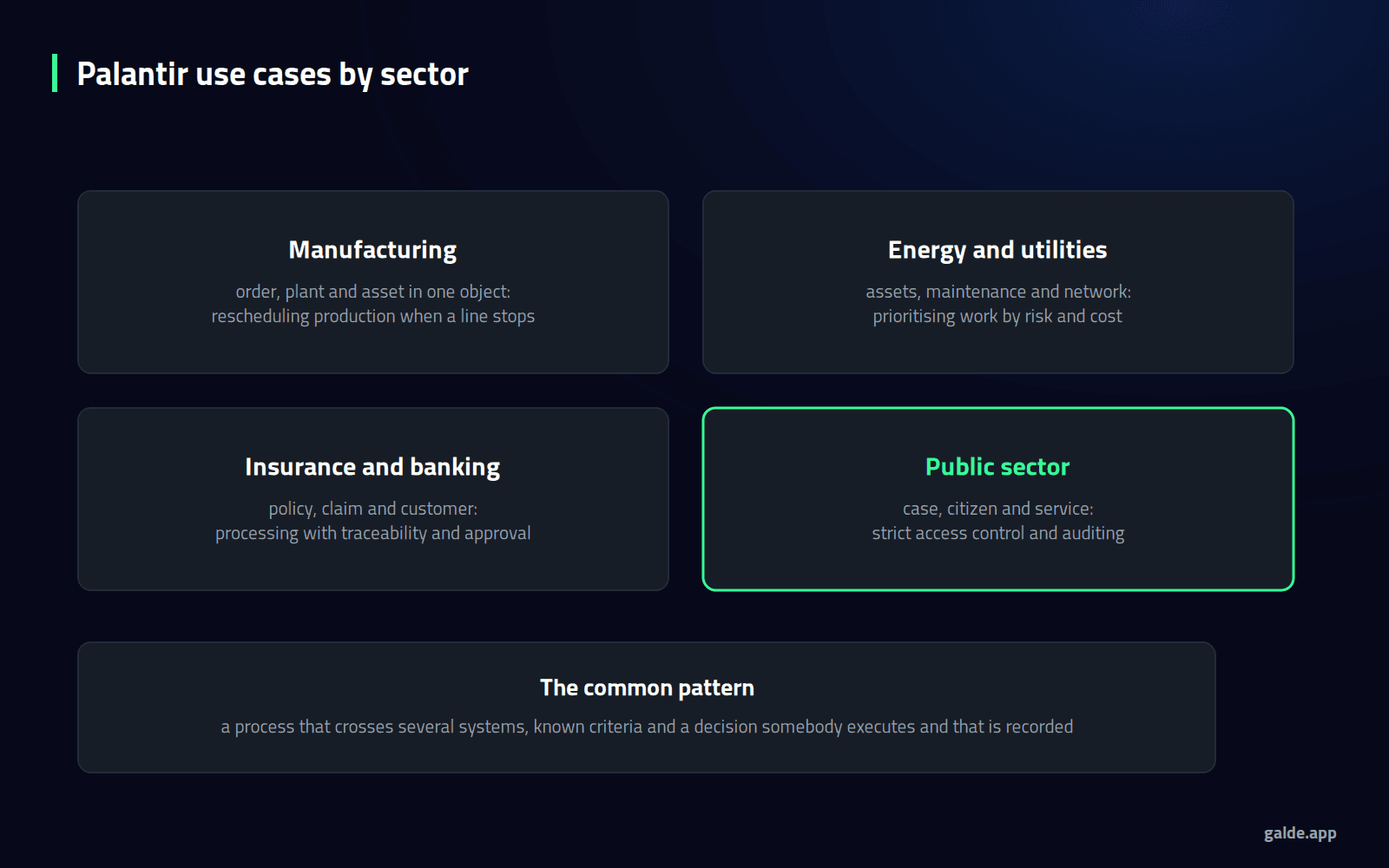
The Palantir Foundry cases that work share a pattern, and they always rest on the objects and actions described in the Ontology documentation: a process that crosses several systems, with known criteria and a decision somebody executes that is recorded. The sector and the vocabulary change; the structure does not.
In manufacturing it is usually production rescheduling or supply; in energy and utilities, prioritising work on assets; in insurance and banking, processing with traceability; in the public sector, the case file with strict access control.
The cases that do not work share a pattern too: when the expected outcome is a dashboard, when everything lives in a single system, or when nobody has authority to execute the decision at the end.
If the outcome is a chart, it is not a Palantir case. If the outcome is an executed decision, it may be.
In the evaluations we support, the most common mistake is not picking the wrong sector but picking the wrong first case within the right sector. The most visible process gets chosen instead of the most bounded one, and two months later there is plenty of conversation and no executed action.
A good first case is one a person does today by jumping between five screens, and that repeats every week.
Manufacturing
The central object is usually the order, linked to the plant, the line and the asset. The typical case is rescheduling when something breaks: a line stops, and somebody has to decide which orders move, to which plant and with what impact on the customer.
A widely cited public reference is the miner Rio Tinto, which according to its joint announcement with Palantir built an ontology in Foundry integrating data from thousands of sensors and uses it as a single source for risk and asset management.
Energy and Utilities
Here the object is the asset and its maintenance, linked to the network and the work order. The typical case is prioritising interventions by combining risk, cost and crew availability, instead of following a fixed calendar.
In Spain, Palantir announced in 2025 an agreement with Valoriza, one of the country's leading environmental services companies, to apply Foundry and AIP to its waste management and urban services operations.
Insurance and Banking
The object is the policy, the claim or the case, linked to the customer and the history. The typical case is processing: cross-checking terms, customer data and prior records to propose a resolution that a person confirms, leaving a record of who decided what.
It is where the combination of governed actions and agents adds most, as we explain in Palantir AIP: the agent proposes, the person confirms, and everything is audited.
Public Sector
The object is the case file and the service delivered to the citizen. What decides the fit is not the process but the access control: strict separation between bodies, sensitive categories protected with mandatory controls and full auditing. It is also where the deployment and sovereignty conversation weighs most, which we cover in Palantir and data sovereignty in Europe.
How to Choose the First Case
Five criteria we use with clients:
- Frequency: it happens at least weekly.
- Measurable current cost: hours, delays or errors somebody can quantify today.
- Crosses systems: at least two, ideally with different permissions.
- Ends in an action: somebody executes something, not just reads.
- Has an owner: a person with authority to decide definitions and exceptions.
If a case meets all five, it fits the calendar we describe in a Palantir deployment in 60 days.
Signs a Case Does Not Fit
- The expected deliverable is a dashboard.
- All the data lives in a single system that already has its interface.
- Nobody has authority to execute the final decision.
- The process changes its rules monthly and nobody knows which apply today.
Clear on the sector but not on the first process?
At Galde we deploy Palantir Foundry in multinational corporations in regulated sectors and in public administrations. We help choose the first case with measurable criteria and take it to production, not to a demo.

How Galde Can Help
Through our Palantir consulting and implementation, we select the case, model the objects needed and deliver the whole process with its permissions.
Through data governance, we define classification and separation between subsidiaries or bodies before modelling starts.
And through data platforms, we connect the source systems and sustain the quality of the data feeding those objects.
Conclusion
The sector changes the vocabulary, not the pattern. In manufacturing, energy, insurance or public administration, the cases that work are frequent processes that cross systems, apply known criteria and end in a decision that is executed and recorded. Choosing the first one well matters more than choosing the sector well, because it decides whether there will be a second.
Palantir®, Foundry® and AIP® are trademarks of Palantir Technologies Inc. Galde is not an official Palantir partner and is not affiliated with the company; we implement the platform for our clients. References to specific organisations come from public announcements by the parties involved.
Frequently Asked Questions
In which sectors is Palantir Foundry most used?
Historically in defence and the public sector, and for years now in manufacturing, energy, healthcare, insurance and banking. The common factor is not the sector but processes that cross systems and end in decisions that must be recorded.
Are there public cases in Spain?
Yes. Palantir announced an agreement with Valoriza in 2025 to apply Foundry and AIP to its waste management and urban services operations.
Does it work for a mid-sized company?
It depends on the process, not the size. If the process crosses systems, has a measurable cost and ends in an action, the fit is possible; if the goal is analytical, there are usually cheaper options.
What makes a good first case?
One that is frequent, has a measurable current cost, crosses at least two systems, ends in an executed action and has a business owner with authority to decide.
How long before the first case shows value?
With a bounded scope, around eight weeks to production. Value shows when the team stops using the old screens, not when the process is deployed.