Palantir AIP: Taking AI Agents to Production with Governance

Which part of the work the platform saves you, and which part is still yours
Quick Answer
Most generative AI pilots fail not because of the model but because of everything around it: business context, permissions, evaluation and production controls. Palantir AIP provides those four things by building on the Ontology, which already holds the business objects, their relationships and the permitted actions.
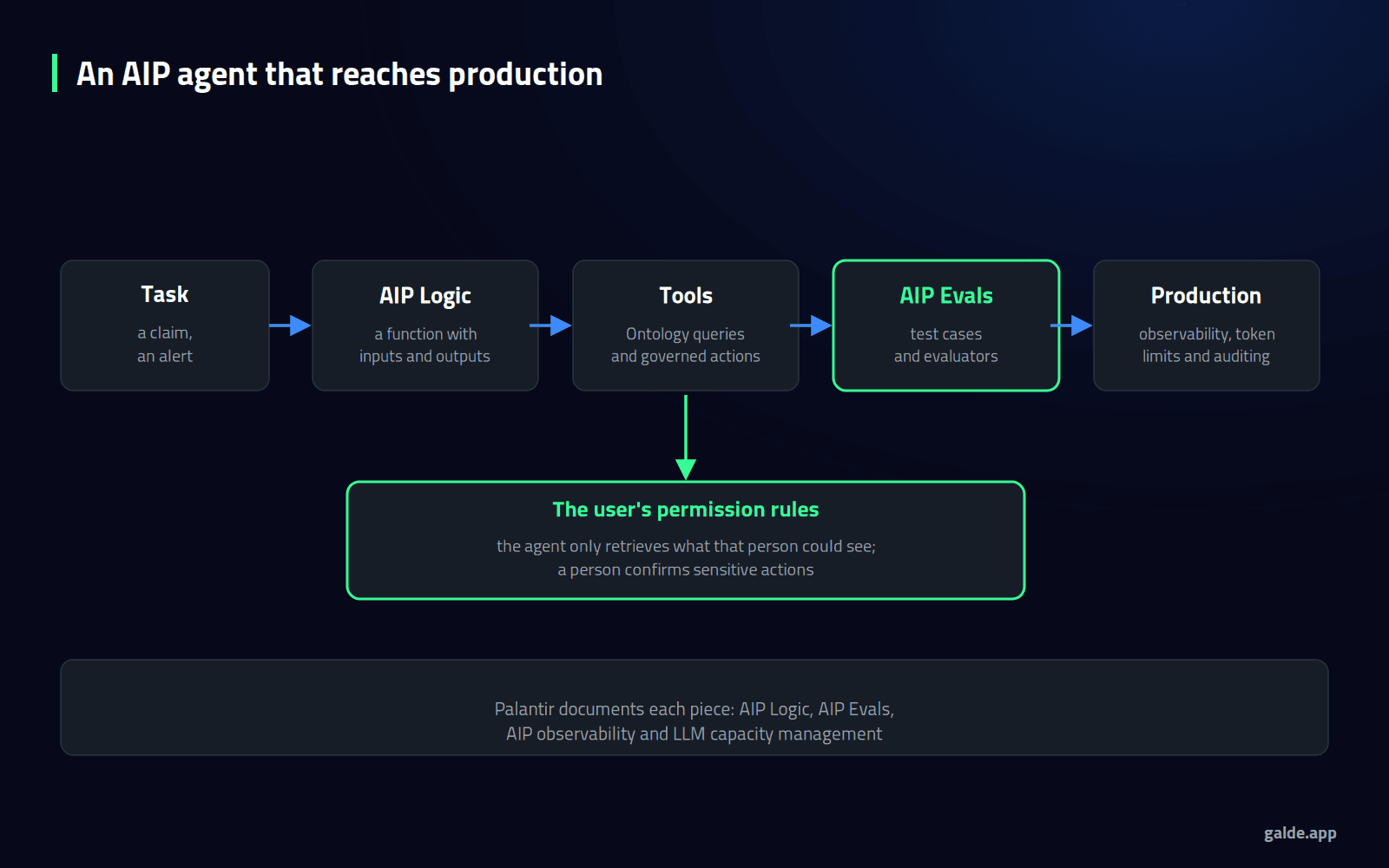
In practice, an AIP agent is built as a function with inputs and outputs, given tools — Ontology queries and governed actions — tested against evaluation cases, and deployed with observability, consumption limits and auditing.
What does not change: you still have to bound the task properly, decide which actions are irreversible and maintain the tests. The platform reduces the plumbing, not the responsibility to design.
The model is the easy part. Context, permissions and testing are the project.
In our deployments, the generative AI conversation inside a regulated corporation always ends at the same three questions: who guarantees the assistant will not show an employee data from another subsidiary, who raises the alarm if answer quality drops after a change, and who answers for it if the system takes a wrong action.
A bespoke pilot answers "we'll look at that later". A platform like AIP forces those answers up front, because its design revolves around those three questions.
An agent without inherited permissions is not an assistant. It is a well-written back door.
Choosing the Model Without Rebuilding the Application
AIP separates the application from the model that runs it. The documentation describes several routes: the model catalogue, bringing your own model through an external service, and self-hosting open-source or custom models on your own infrastructure, including on-premise and air-gapped environments.
For a European company that last option is not a detail: it allows sensitive data to stay within a defined perimeter, and it is the conversation we open in Palantir and data sovereignty in Europe.
Switching provider does not force an application rewrite, but it does force retesting: two models read the same instruction differently.
The Context the Model Does Not Have
A language model arrives knowing nothing about your suppliers, which orders are open or who may approve a change. That context is the Ontology, which is why its role in data governance is also the key to AI: the agent does not query loose tables but objects with their relationships and actions.
The difference from a bespoke RAG system is that there is no second model of the business to maintain. It is the same one used by applications and analytics.
How an Agent Is Built in AIP
- AIP Logic is a function with inputs and outputs where you define the instruction, the available tools and the permitted actions. It is tested before any application calls it.
- Tools are Ontology queries and governed actions rather than generic APIs: the agent can only do what the object model allows.
- Automate triggers that logic on a condition or a schedule, so the agent reacts without anyone invoking it.
- AIP Analyst covers the open question by exploring the Ontology, when the work is not bounded in advance.
The User's Permissions Rule
This is the point that reassures a security committee most. Access to an assistant does not grant access to the data behind it: the agent works within the permissions of the person asking, and the platform's security controls continue to apply while models run, according to the AIP security documentation.
Our design recommendation, especially in regulated sectors: have the agent propose the sensitive action and have a person confirm it before the governed operation runs.
Test Before, and Keep Testing After
With a model, the wording of an answer varies between runs, so testing cannot mean comparing text. AIP Evals keeps reusable cases and evaluators to check what actually matters: whether business rules and approval requirements hold, whether the right evidence is retrieved and what each run costs.
That enables four checks you would otherwise build by hand: comparing two providers on the same cases, testing a new version against the one in production, repeating the same input to measure variation, and rerunning everything after someone edits an instruction or a tool.
What Production Adds
Three pieces usually missing from pilots that the platform brings as standard: AIP observability, with execution history, traces and logs to reconstruct why a decision was made; capacity management, with token and request limits per project; and usage tracking, so you know which application is spending what.
Build, or Use the Platform?
Our rule, after doing both: if your case lives inside processes already modelled in Foundry, building it outside means maintaining a second model of the business and reimplementing permissions, evaluation and auditing. If the case is a product of its own, with its interface and lifecycle, building may make sense, and then the cautions we set out in agentic RAG apply.
Do you have an AI pilot that works in the demo and stalls at the security committee?
At Galde we design agents on Palantir AIP in multinational corporations in regulated sectors: a bounded task, inherited permissions, automated evaluation and human approval where it belongs.

How Galde Can Help with AIP
Through our Palantir consulting and implementation, we define the agent's scope, the tools it receives and the actions it may run, along with the tests that hold it up in production.
Through generative AI, we bring in what we have learned outside the platform: quality evaluation, cost control and interaction design.
And through data governance, we make sure the objects feeding the agent have an owner, a classification and a known freshness.
Conclusion
AIP does not make generative AI work on its own. It puts the work that decides whether it works — context, permissions, testing and control — inside the same platform where the data and the actions already live. For a corporation already operating on Foundry, building that stack outside means maintaining the same model of the business twice. For everyone else, the question remains whether the case justifies the platform.
Palantir®, Foundry® and AIP® are trademarks of Palantir Technologies Inc. Galde is not an official Palantir partner and is not affiliated with the company; we implement the platform for our clients.
Frequently Asked Questions
What is AIP Logic?
A function with inputs and outputs where you define the model's instruction, the tools it may use and the actions it is permitted to take. It is tested in isolation before an application invokes it.
Can an AIP agent see data the user should not see?
It should not: the agent works within the permissions of the user asking, and platform controls continue to apply while the model runs. It is also worth requiring it to cite the sources it retrieved.
Can you use your own or self-hosted models?
Yes. The documentation describes the model catalogue, connecting your own model through an external service, and self-hosting on the customer's infrastructure, including environments with no internet access.
How do you measure an agent's quality?
With reusable evaluation cases and evaluators that check business rules, approval requirements and retrieved evidence, alongside the duration and token consumption of each run.
Is it worth building our own agent stack?
If the process is already modelled in Foundry, building outside forces you to maintain a second model of the business and reimplement permissions, evaluation and auditing. If it is a product of its own, with its interface and lifecycle, it can pay off.