
A Palantir Deployment in 60 Days: From Workshop to Production

What can genuinely be delivered in two months, and what cannot
Quick Answer
A first Palantir Foundry case can be in production in 60 days if it is properly bounded: one process that crosses two or three systems, the minimum objects to support it, one governed action and the people who will use it.
What does not fit in 60 days is modelling the whole organisation, migrating the data warehouse or replacing every report. Attempting it is the most common way to end the quarter with a demo and no decision executed.
The condition that makes it possible is not technical: you need a technical sponsor with two hours a week and a business owner who decides how each object is modelled. Without that, the calendar stretches through waiting, not difficulty.
Sixty days does not transform a company. It proves, in production, that it can be done.
Palantir has popularised intensive customer workshops, which its documentation mentions as a way of achieving outcomes with AI within hours. They are effective for convincing people and for learning the tool. But a workshop is not a deployment: when it ends, the work on permissions, quality, owners and operations is still ahead.
Our methodology is designed for exactly that stretch: the one between a convincing demo and something used on Monday morning.
The question is not whether something can be shown in two weeks. It is whether anyone will be using it in month three.
The Four Phases
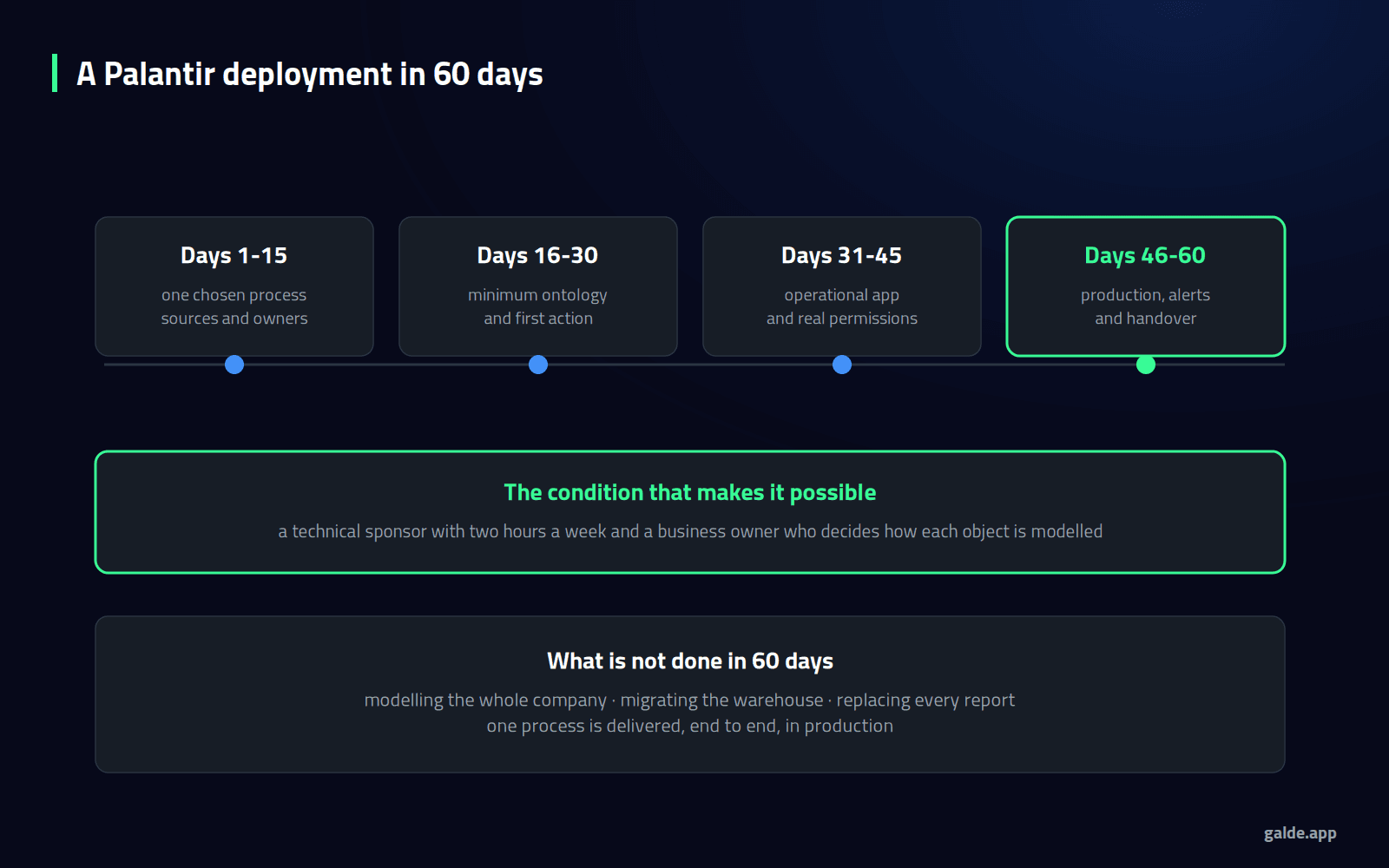
Days 1 to 15 · Choose the Process and the Sources
Pick a frequent, costly process with a clear success criterion, and identify the systems to connect, their actual rate of change and their permissions. In parallel, name the business owner. This phase decides the success of everything after it.
Days 16 to 30 · Minimum Ontology and First Action
Model the essential objects — usually fewer than ten — with their links, and implement a single action: the one done by email today. Here we apply what we explain in the Ontology from a governance view: model how the business sees things, not how the ERP stores them.
Days 31 to 45 · Operational Application and Real Permissions
Build the screen the team will use and apply permissions for real, including mandatory controls for sensitive categories. This is when the exceptions that appear in no manual show up, which is why it should come early.
Days 46 to 60 · Production, Alerts and Handover
The process goes into production with a real group of users, quality alerts are configured and the handover to the internal team happens. The closing criterion is not "it is deployed" but somebody used it this week without help.
What Is Deliberately Left Out
- Modelling domains nobody will operate yet.
- Migrating the warehouse or lakehouse: they coexist, as we explain in Palantir, Databricks or Snowflake.
- Replacing existing reports.
- Opening five environments when one is enough for the first case.
The Five Conditions That Actually Matter
- One process, not an area. The more concrete, the faster.
- A business owner with authority to decide definitions and exceptions.
- Access to source systems from week one; this is the most common delay.
- A blended team with your people from day one, so handover is not a final event.
- A measurable success criterion agreed before starting: cycle time, errors avoided, decisions executed.
How It Is Measured
Our recommendation is to fix three numbers before starting and measure them again on day 60: how long the process takes today, how many people and screens are involved and how many decisions are executed without being reopened. If those three numbers have not moved by the end, the problem is not the platform: it is the scope that was chosen.
Has your Palantir evaluation been stuck in workshop phase for months?
At Galde we deploy Palantir Foundry in multinational corporations and public administrations with this approach: a bounded process in production, with real permissions and handover to your team.

How Galde Can Help
Through our Palantir consulting and implementation, we bound the first case, model the minimum Ontology and take the action into production with its permissions.
Through data governance, we leave owners, classification and quality thresholds defined for that case before it is expanded.
And through data platforms, we connect the sources without duplicating what you already have and build the alerts that sustain the process.
Conclusion
Sixty days is not enough to transform a company, but it is enough for something more useful at that stage: proving with a real process, in production and with real permissions, that the platform solves a problem that was costing money. From there the conversation changes register, because it is no longer about capabilities but about which process comes next.
Palantir®, Foundry® and AIP® are trademarks of Palantir Technologies Inc. Galde is not an official Palantir partner and is not affiliated with the company; we implement the platform for our clients.
Frequently Asked Questions
Is it realistic to put Palantir into production in 60 days?
Yes, for a bounded process that crosses two or three systems and ends in a governed action. It is not realistic for modelling the whole organisation or migrating the analytical platform.
What is the difference between an intensive workshop and a deployment?
A workshop demonstrates capabilities quickly and helps people learn the tool. A deployment adds what makes it survive: real permissions, monitored quality, owners and handover to the internal team.
How many people are needed?
A small blended team: implementation profiles from the vendor and, on the customer side, a technical sponsor with two hours a week and a business owner who decides. Large teams early on tend to slow things down.
What delays a first case the most?
Access to source systems, and the absence of a business decision on how each object is modelled. It is almost never the technology.
What happens after the 60 days?
You pick the next process with the same criteria and reuse what is already modelled. The Ontology's value compounds when each new case builds on the previous one's objects.