Palantir, Databricks or Snowflake: When to Choose Each

An honest comparison between three platforms that are compared badly, because they rarely solve the same problem
Quick Answer
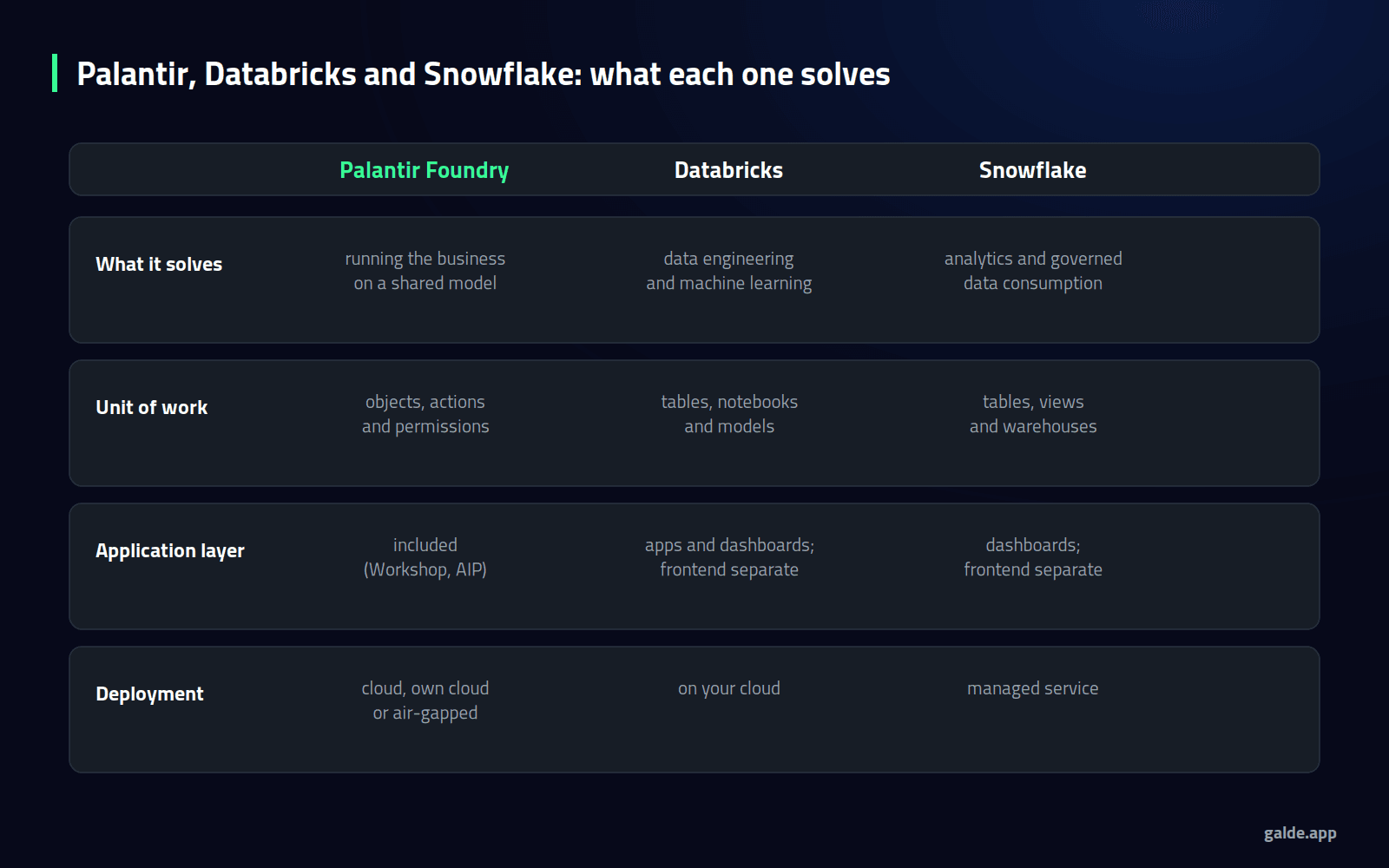
Snowflake solves governed analytical consumption: one place where many people query reliable data without fighting over capacity. Databricks solves data engineering and machine learning: transforming large volumes and training models on them. Palantir Foundry solves something else: running the business on a shared model, with applications, actions and permissions on top of it.
That is why "which one do I choose?" is usually the wrong question. In the large corporations we know, they normally coexist: the warehouse or lakehouse remains the analytical base, and Foundry takes on the processes that cross systems and end in a decision.
The decision that does matter is a different one: avoid paying twice for the same layer. Duplicating ingestion, modelling and governance across two platforms is what makes these projects expensive.
It is not a three-way fight. It is a question about which layer you are missing.
In a European industrial multinational the conversation usually arrives like this: there is already a lakehouse with hundreds of tables, an engineering team maintaining it and dashboards that work. And still, when a plant stops a line, the planner is cross-checking three screens and an email. Somebody suggests Palantir, and the meeting turns into a comparison of platforms that do not share a purpose.
Comparing Foundry with Snowflake is like comparing an operating theatre with a medical supply room. You need both.
What Each One Does Well
Snowflake
Analytical consumption at scale, with a clean separation of storage and compute, mature governance over tables and views, and simple operations. Where it shines: many consumers, many queries and a need for cost control per team, which we cover in FinOps in Databricks and Snowflake.
Databricks
Data engineering and machine learning on open formats, with the muscle for large jobs and complex data flows. Where it shines: heavy transformation, data science and technical teams that live in code. The choice between lakehouse and classic warehouse is covered in Lakehouse architecture versus Data Warehouse.
Palantir Foundry
Operations: a model of the business — the Ontology — with actions and permissions, applications built on it without a frontend team, and deployment in demanding environments, including air-gapped ones. Where it shines: processes that cross subsidiaries and systems, regulated sectors and decisions that must be recorded.
Where They Really Overlap
| Layer | Overlap |
|---|---|
| Ingestion and transformation | High: all three can do it. Choose one and do not repeat it |
| Analytical storage | High between Databricks and Snowflake; Foundry can read without copying |
| Semantic model | Partial: all three have one; only Foundry's executes actions |
| Operational applications | Low: this is Foundry's own ground |
| Governance with controls that travel with data | Low: this is where Foundry is strongest |
High overlap is what to resolve before signing. Low overlap is what justifies running two platforms.
How They Coexist in Practice
The pattern that works best in the deployments we run:
- The lakehouse or warehouse remains the analytical source, with its engineering and its costs already under control.
- Foundry reads that data without duplicating it where possible. Its platform overview describes zero-copy access to existing lakes and platforms.
- The Ontology is built only for the processes that will be operated, not for the whole catalogue.
- Governance is shared: classification and mandatory controls are defined once and applied wherever each piece of data lives.
How to Decide in Your Case
Five questions are usually enough:
- Is the expected outcome a dashboard or a decision executed against a system?
- Does the process cross several subsidiaries and systems, or live in one?
- Do you need access controls to follow the data as it is derived and exported?
- Is there a requirement to deploy outside the public cloud?
- Is there a business owner willing to model and maintain the objects?
Three or more answers on the operational side point to Foundry. If the analytical ones dominate, the answer lies in the platform you already have, and probably in using it better.
Have you been shown three platforms, and no description explains which layer you are missing?
At Galde we deploy Palantir Foundry in multinational corporations and, at the same time, build platforms on Databricks and Snowflake. That dual position lets us say plainly when Foundry adds a layer you do not have, and when it would only duplicate the one you already pay for.

How Galde Can Help You Decide
Through our Palantir consulting and implementation, we assess how Foundry actually fits against what you already run, and design coexistence rather than replacement.
Through data platforms, we review the current architecture, its cost and its duplication before adding anything new.
And through data governance, we unify definitions, classification and ownership so you do not end up with two parallel governance models, one per platform.
Conclusion
The three platforms are compared badly because they solve different layers: analytical consumption, data engineering and business operations. In a large corporation they almost always coexist, and the value of the decision is not in picking a brand but in avoiding paying twice for ingestion, modelling and governance. Before comparing prices, it is worth knowing which layer is genuinely missing.
Palantir®, Foundry® and AIP® are trademarks of Palantir Technologies Inc. Databricks® and Snowflake® are trademarks of their respective owners. Galde is not an official Palantir partner and is not affiliated with the company; we implement the platform for our clients.
Frequently Asked Questions
Does Palantir Foundry replace Databricks or Snowflake?
Usually not. Foundry can access data where it already lives and, in the corporations we know, it coexists with the lakehouse or corporate warehouse, which remain the analytical base.
Which one is more expensive?
It depends on usage, not on the label. In Databricks and Snowflake the main cost is compute and grows with queries; in Foundry the cost is tied to platform scope and to the people operating it. Comparing licences without comparing usage models leads to wrong conclusions.
Can you run all three without duplicating data?
Yes, if you settle on a single ingestion layer and avoid rebuilding transformations in two places. The problem is not technical but a matter of architectural discipline.
What happens to governance with several platforms?
Definitions and classification should be decided once and enforced in each platform with its own mechanisms. Running two parallel governance models is the fast route to two numbers for the same metric.
When does Palantir not make sense?
When the expected outcome is analytical, the process lives in a single system and there are no strong traceability or restricted-deployment requirements. In that case, the platform you already have is usually enough.