
What a Palantir Deployment Costs: The Line Items Nobody Details

What you actually pay for, what inflates the bill and how to bound it before signing
Quick Answer
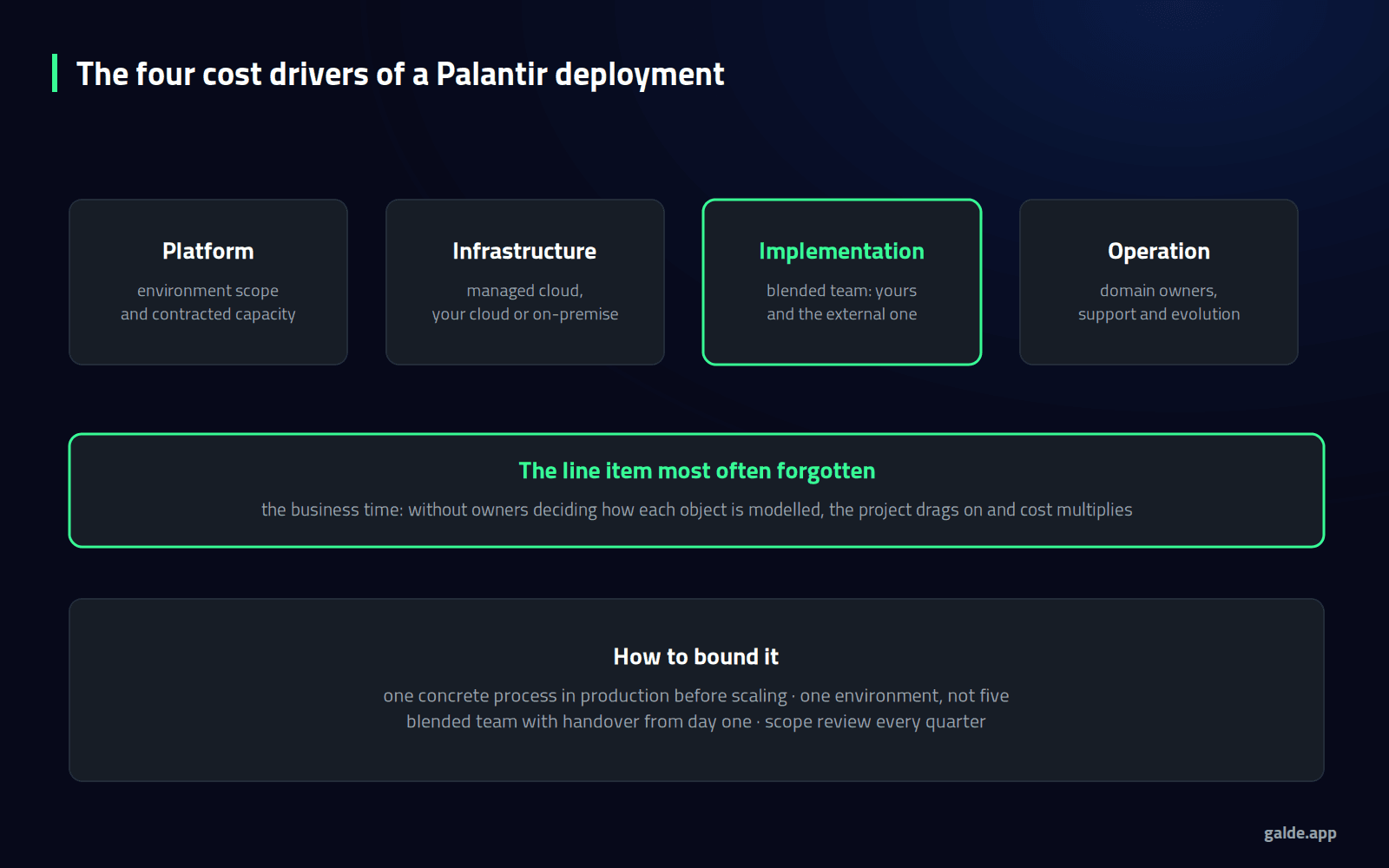
Palantir does not publish price lists, so any specific figure circulating online deserves caution. What can be described precisely are the four line items of a deployment: the platform, according to environment scope and contracted capacity; the infrastructure it runs on; the implementation, which is people's work; and the operation afterwards, with domain owners and support.
The item most often underestimated appears in no proposal: the business's time. Without somebody deciding how each object is modelled, the project drags on, and in a deployment, time is the cost multiplier.
Comparing Palantir with the per-terabyte price of a data warehouse leads to the wrong conclusions. The useful comparison is against the current cost of the process you want to change.
"What does Palantir cost" has no answer. "What does solving this process cost" does.
In the buying conversations we support, finance asks for a number and the conversation stalls, because the number depends on scope and scope has not been decided. Our practical advice is to reverse the order: bound the process first, ask for a price second. A concrete scope turns an open negotiation into a comparison of alternatives.
Budgets do not blow up because of unit price. They blow up because of scope.
The Four Line Items
1 · Platform
This is the vendor contract, and it depends on environment scope and contracted capacity. In the AI layer, model consumption is measured and can be tracked per application, as Palantir documents in AIP usage tracking and capacity management, which allows limits per project.
2 · Infrastructure
This varies widely by scenario: managed service, deployment in your own cloud, or an on-premise or air-gapped environment. The more control, the more operational cost you carry. It is the decision we cover in Palantir and data sovereignty in Europe.
3 · Implementation
This is people's work: source integration, Ontology modelling, applications and permissions. What really moves this item is not the day rate but how many weeks it lasts.
4 · Operation
What it costs to keep what you built alive: domain owners who decide, support, model evolution and quality monitoring. It is the item forgotten in the business case, and it determines whether the project survives its second year.
What Inflates the Bill
- Modelling the whole company before delivering anything. The classic, and it multiplies weeks without producing value.
- Duplicating layers. If ingestion and transformation are rebuilt inside when they already exist outside, you pay twice. We develop this in Palantir, Databricks or Snowflake.
- Multiplying environments. Each additional environment adds administration, permissions and testing.
- Having no owners. Without business decisions, the technical team waits; and waiting, in a deployment, is the most expensive way to work.
- AI pilots with no consumption limits. Setting per-project limits from the start avoids surprises and is trivial to configure.
How to Bound It Before Signing
- Choose a process, not an area. One that crosses two or three systems and ends in a decision.
- Set a date: what has to be in production in 60 days.
- Fix one environment, not five, and expand later.
- Require a blended team with handover from day one, so operations do not depend on the vendor.
- Review scope quarterly, with the process metric in front of you.
How to Compare with the Alternative
The most common mistake is comparing the contract with the cost of a data warehouse. The useful comparison is against what the process costs today: hours of people cross-checking screens, delayed decisions, errors corrected late, or the cost of building and maintaining the same application, permission and traceability layer yourselves.
If that sum does not work for one concrete process, it will not work for ten.
Are you being asked for a number before the scope has been decided?
At Galde we deploy Palantir Foundry in multinational corporations and public administrations. We help bound the scope before the negotiation, which is where the cost of the project is actually decided.

How Galde Can Help
Through our Palantir consulting and implementation, we bound the first case, estimate the real effort and design the handover to your team from the start.
Through data platforms, we review which layers you already pay for, so they are not duplicated inside the platform.
And our methodology sets the commitment that bounds cost the most: a data product in production in 60 days.
Conclusion
There is no Palantir list price, and chasing one distracts from the question that does have an answer: what it costs to solve one concrete process, and what it costs today not to solve it. The four line items are known and controllable; what blows up a budget is open scope, duplicated layers and the absence of owners who decide. Bound the case, set a date, and negotiate afterwards.
Palantir®, Foundry® and AIP® are trademarks of Palantir Technologies Inc. Galde is not an official Palantir partner and is not affiliated with the company; we implement the platform for our clients. This article contains no Palantir pricing or contractual estimates.
Frequently Asked Questions
How much does a Palantir licence cost?
Palantir does not publish price lists, and cost depends on environment scope and contracted capacity. Any specific figure circulating without that context is unreliable.
Is it more expensive than Databricks or Snowflake?
They are different models. In those platforms the main cost is compute and grows with analytical use; in Palantir it is tied to platform scope and the team operating it. An honest comparison is made on a concrete use case.
How much of the cost is implementation and how much platform?
It varies, but in a first bounded case the people's work usually weighs more than leadership expects. That is why project duration is the most important cost lever.
How do you control spending in the AI layer?
With token and request limits per project and with usage tracking per application, both documented by Palantir. They are worth switching on before the first pilot, not after.
When does it not pay off financially?
When the expected outcome is analytical, the process lives in a single system and there are no traceability or restricted-deployment requirements. In that case, the platform you already have is usually enough.