Avoiding Palantir Lock-In: Portability and an Exit Strategy

The conversation worth having on day one, not on the last day
Quick Answer
Every operational platform creates dependency, and Palantir is no exception. The useful question is not how to avoid it entirely — you cannot, without giving up the value — but how much dependency you are accepting, and in exchange for what.
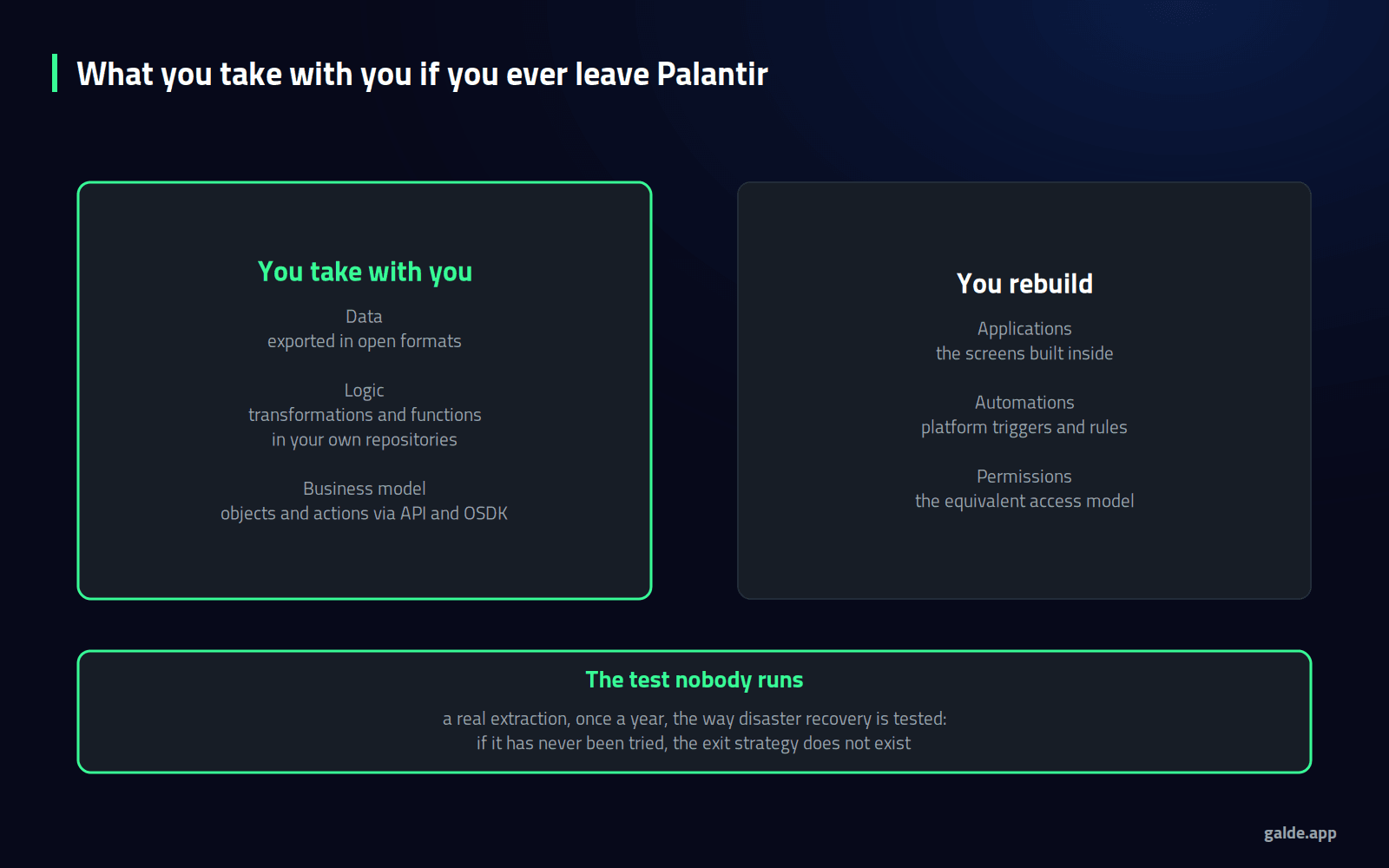
In practice, you take with you: the data, exportable in open formats; the logic, if you keep transformations and functions in your own repositories; and the business model, reachable through APIs and the Ontology SDK. You rebuild: the applications built inside the platform, the automations and the equivalent permission model.
And there is a test almost nobody runs: a real extraction, once a year. If it has never been tried, the exit strategy does not exist.
It is not about not depending. It is about knowing exactly what you depend on.
In the committees where a platform like this is approved, the dependency question arrives late and badly framed: as an argument against, not as a design requirement. The result is that nobody turns it into concrete tasks, and three years later the organisation discovers its business model lives somewhere it does not know how to leave.
It is exactly the same problem as with an ERP, a data warehouse or a cloud. The difference is addressing it early.
The expensive part is not the dependency. It is discovering it the day you need to leave.
What You Take and What You Rebuild
You Take
- The data. It must be exportable in open formats and with its structure, not as an unreadable dump.
- The logic. The transformations and functions you write are yours if they live in repositories you control.
- The business model. Objects, links and actions are reachable through the platform APIs and the Ontology SDK, which allows the model to be rebuilt elsewhere without starting from zero.
You Rebuild
- The applications built inside the platform, because their interface and behaviour belong to it.
- The automations that trigger actions on conditions or schedules.
- The permission model, which would have to be reproduced with the target platform's equivalent mechanisms, usually weaker ones.
That split is the honest answer to the committee's question: you take the asset — data, logic and model — and you rebuild the experience.
Five Practices That Reduce Dependency from Day One
- Code in your repositories. Transformations and functions versioned outside the platform wherever the platform allows it.
- Document the model as a contract. Objects, properties, links and actions described in a living document, independent of the tool.
- Do not hide business rules in the interface. A rule that lives only in a screen's configuration cannot be taken anywhere.
- Keep the source of truth outside when there is no reason to move it. Zero-copy access to your lake or warehouse reduces the exit surface, as we discuss in Palantir, Databricks or Snowflake.
- Use documented interfaces. What is built against the developer toolchain and the SDK is more portable than what is hand-built inside.
What to Negotiate in the Contract
Four clauses worth settling before signing, because afterwards they lose force:
- Export: format, scope and timeframe for a full extraction on request.
- Exit assistance: an obligation to cooperate in a transition, and for how long.
- Notice and renewal: notice periods and price revision conditions.
- Ownership: stating in writing that the model, the logic and the derived data are yours.
The Annual Exit Test
What works, and almost nobody does, is treating the exit the way disaster recovery is treated: a real test, once a year, with three measurable goals.
- Extract one domain's data and verify it can be read and loaded elsewhere.
- Rebuild one object and one action outside the platform, even at reduced scale.
- Time how long the team would need to rebuild one specific application.
With those three numbers, the committee stops arguing about dependency in the abstract.
The Honest Counterpoint
Reducing dependency has a cost. If you use neither the platform's applications nor its automations, you will be paying for capabilities you do not use and losing precisely the part that justifies the purchase, as we explain in what Palantir is. The sensible strategy is not to minimise dependency at all costs but to concentrate it where it pays while keeping data, logic and model portable.
Is your committee asking about lock-in and nobody has an answer with numbers?
At Galde we deploy Palantir Foundry in multinational corporations and public administrations, and we design from the start what stays in your hands: repositories, a documented model and an exit test that is actually run.

How Galde Can Help
Through our Palantir consulting and implementation, we define what gets built inside, what stays outside and how the model is documented so it remains portable.
Through data platforms, we keep the source of truth and the pipelines in your architecture when there is no reason to move them.
And through data governance, we put ownership, classification and the extraction procedure an auditor expects in writing.
Conclusion
Dependency on an operational platform is not avoided with a clause but with repeated design decisions: code in your repositories, a documented model, rules kept out of the interface, and an extraction tested every year. With that, the conversation about leaving Palantir stops being a matter of principle and becomes a plan with dates. Which is exactly what a committee needs in order to decide calmly.
Palantir®, Foundry® and AIP® are trademarks of Palantir Technologies Inc. Galde is not an official Palantir partner and is not affiliated with the company; we implement the platform for our clients. This article is not legal or contractual advice.
Frequently Asked Questions
Can data be taken out of Palantir Foundry?
Yes. Data should be exportable in open formats, and it is worth proving it with a real extraction before signing, rather than when the need arises.
What happens to the applications if we leave the platform?
Applications built inside have to be rebuilt, because their behaviour belongs to the platform. What you keep is the underlying asset: the data, the versioned logic and the object model.
Can the Ontology be rebuilt elsewhere?
The model — objects, links and actions — is reachable through APIs and the Ontology SDK, so it can be rebuilt on another technology. What does not transfer automatically are the permission and traceability guarantees.
Which clauses are worth negotiating?
Full export with format and timeframe, assistance during a transition, notice periods and price revision conditions, and explicit ownership of the model, the logic and the derived data.
Is it possible to use Palantir without creating dependency?
Not entirely, just as with an ERP or a cloud. The reasonable approach is to concentrate dependency where it adds value and keep the data, the logic and the business model portable.