What Is Palantir? Foundry, AIP and the Ontology Explained

A guide for anyone who has to decide whether Palantir fits their company, and what for
Quick Answer
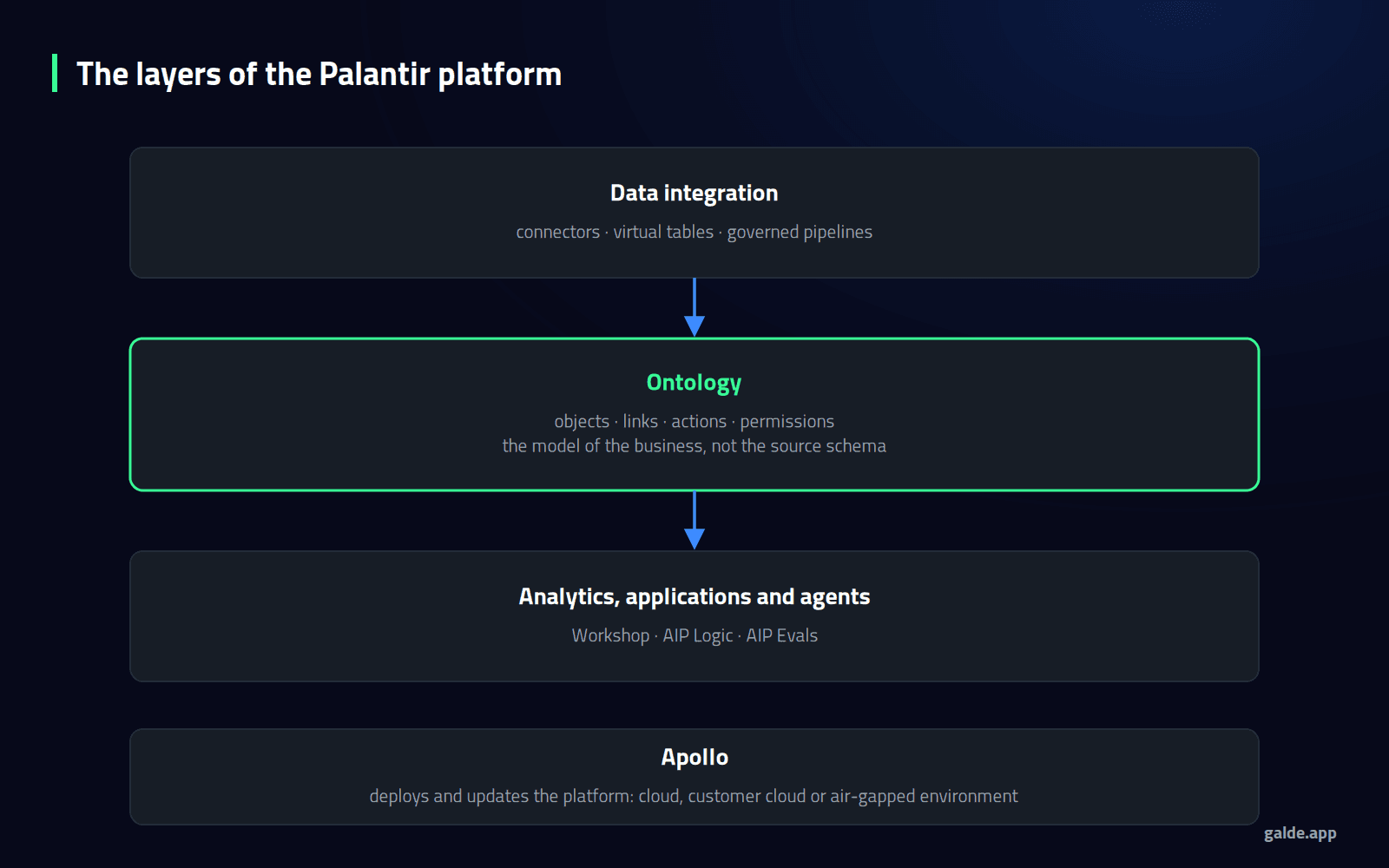
Palantir is not a data warehouse or a lakehouse. It is an operational platform made of three pieces that Palantir documents as a single architecture: Foundry, the data operations platform; AIP, the generative AI layer connected to those operations; and Apollo, which deploys and updates all of the above, whether in the cloud, in the customer's cloud or in an air-gapped environment.
What binds them together, and what really sets Palantir apart, is the Ontology: a model of the business made of objects — an order, a turbine, a policy — the links between them, the actions that can be taken and the permissions that govern them.
The practical consequence is that buying Palantir is not a storage decision but an operational one: you buy it so that people and agents work on a shared model of the business, not to store data more cheaply.
A data warehouse answers questions. The Ontology also lets you do something with the answer.
A European multinational with plants on three continents usually has the same problem described in five different ways. The ERP knows which orders are open, the maintenance system knows which machine is down, the CRM knows which customer is waiting for that shipment, and a spreadsheet knows what the planner decided last time. Each system has its own idea of what an "order" is.
When that company evaluates Palantir, the question that reaches the table is rarely well framed: "does it replace our data warehouse?". The short answer is usually no. The useful answer requires understanding what each piece does.
Palantir does not compete over where data is stored, but over where decisions are made.
The Three Pieces: Foundry, AIP and Apollo
Palantir's architecture documentation describes the three platforms and how they fit together:
- Foundry is the data operations platform: integration, transformation, Ontology development, analytics and workflow.
- AIP is the generative AI platform: connectivity to language models, a toolchain for building agents and automations, applications for end users, and an evaluation framework for governing those workflows in production.
- Apollo is continuous delivery: it manages the infrastructure hosting the other two and orchestrates zero-downtime upgrades across very different environments, including ones with no internet connection.
That third piece explains something that surprises many teams: Palantir can run where most modern enterprise software cannot, such as an isolated network or a deployment in the customer's own data centre.
How the Data Gets In
Before modelling anything, you have to connect the systems already running. Palantir describes a data connection framework that includes zero-copy, in-place access to existing lakes and platforms, alongside batch and streaming pipelines, according to its platform overview.
This matters for one concrete decision: you do not need to migrate all your data into Palantir to start. In many deployments, a good share of the information stays in the lakehouse or the corporate warehouse, and Foundry works on it where it is.
The Ontology: The Piece That Changes Everything
The Ontology is the layer where data stops being a table and becomes a thing in the business. It has four elements:
- Objects: an order, a customer, a turbine, a case file.
- Links: which order serves which plant, which case belongs to which customer.
- Actions: what can be done to an object — reassign, approve, raise an alert — with the permissions that determine which person or agent may run it, and under what conditions.
- Permissions and governance: not an afterthought, but part of the model.
The difference from a BI semantic layer is that third element. A semantic model lets you query. The Ontology also lets you write back to the right system, with a record of who did what.
What Gets Built on Top
On the Ontology, the platform offers the pieces that make up day-to-day work: Workshop for building operational applications without your own frontend, analytics tools, and the AI layer with AIP Logic for model-backed functions, AIP Evals for testing them and the Ontology SDK for building your own applications against that same model.
Security and Governance: What Travels with the Data
For a regulated company, this is the platform's strongest argument. Palantir's security documentation distinguishes two kinds of control:
- Mandatory controls — markings, classification-based access controls and organisations — that travel with each unit of data as it is derived, supported by the platform's provenance and lineage capabilities.
- Discretionary controls, such as resource roles or row and column filtering, which determine what each user sees but do not follow what is exported.
Understanding that distinction avoids the most expensive mistake we see in regulated deployments: relying on a read filter to protect data that somebody later exports.
What Palantir Is Not
- It is not cheap storage. If the problem is compute cost, the answer lies elsewhere; we cover that in FinOps in Databricks and Snowflake.
- It does not necessarily replace your data platform. Coexistence is the norm. We compare the three approaches in Palantir, Databricks or Snowflake.
- It is not a closed IT project. Without a business owner deciding how each object is modelled, the Ontology ends up as a copy of the ERP schema, which is exactly what adds no value.
When It Makes Sense
From our experience deploying Foundry, the platform fits when three conditions hold at once: the process crosses several systems and several subsidiaries, somebody has to decide and act rather than just read a dashboard, and the environment demands serious traceability and access control. If the third is missing, there is almost always a cheaper alternative. If the first two are missing, Palantir will be an expensive warehouse.
Are you evaluating Palantir and need an independent read on whether it fits?
At Galde we deploy Palantir Foundry in multinational corporations, mostly European ones with subsidiaries worldwide, in regulated sectors and public administrations. That includes saying when the platform is not the answer.

How Galde Can Help with Palantir
Through our Palantir consulting and implementation, we design the architecture, connect the source systems and model the Ontology around how the business sees itself, not around how the ERP happens to be built.
Through data governance, we define who owns each object, which actions exist and which mandatory controls apply, so that governance is part of the model rather than a separate document.
And through data platforms, we make Foundry coexist with the data platform you already have, instead of duplicating it.
Conclusion
Palantir is misunderstood when compared with a data warehouse and understood when compared with how the company operates today: five systems, five definitions and a planner jumping between screens. Foundry integrates, the Ontology models, AIP puts AI on top and Apollo deploys it wherever needed. The relevant decision is not technical but operational: if nobody is going to act on the model, you do not need this platform.
Palantir®, Foundry® and AIP® are trademarks of Palantir Technologies Inc. Galde is not an official Palantir partner and is not affiliated with the company; we implement the platform for our clients.
Frequently Asked Questions
Does Palantir replace a data warehouse?
Usually not. Foundry can access data where it already lives, without copying it, and in most deployments it coexists with the corporate warehouse or lakehouse. You buy it to operate on a shared model, not to make storage cheaper.
What is the difference between Foundry and AIP?
Foundry is the data operations platform: integration, Ontology, analytics and applications. AIP is the generative AI layer that builds on it to connect models, build agents and evaluate them before they reach production.
What exactly is the Palantir Ontology?
A model of the business made of objects, the links between them, the actions that can be taken and the permissions that govern them. Unlike an analytics semantic layer, it allows writing back to systems with full traceability.
Can Palantir be deployed without sending data to the public cloud?
Yes. Apollo manages deployment and updates across different environments, including ones in the customer's own infrastructure or isolated from the internet. It is one reason the platform appears in regulated sectors and defence.
How long does a first deployment take to show results?
It depends on scope, but the pattern that works is to bound one process that crosses systems and take it to production in weeks, rather than modelling the whole company before delivering anything.